
Responsible Gambling Tools at UK Online Casinos: A Player’s Guide
 Available in GB
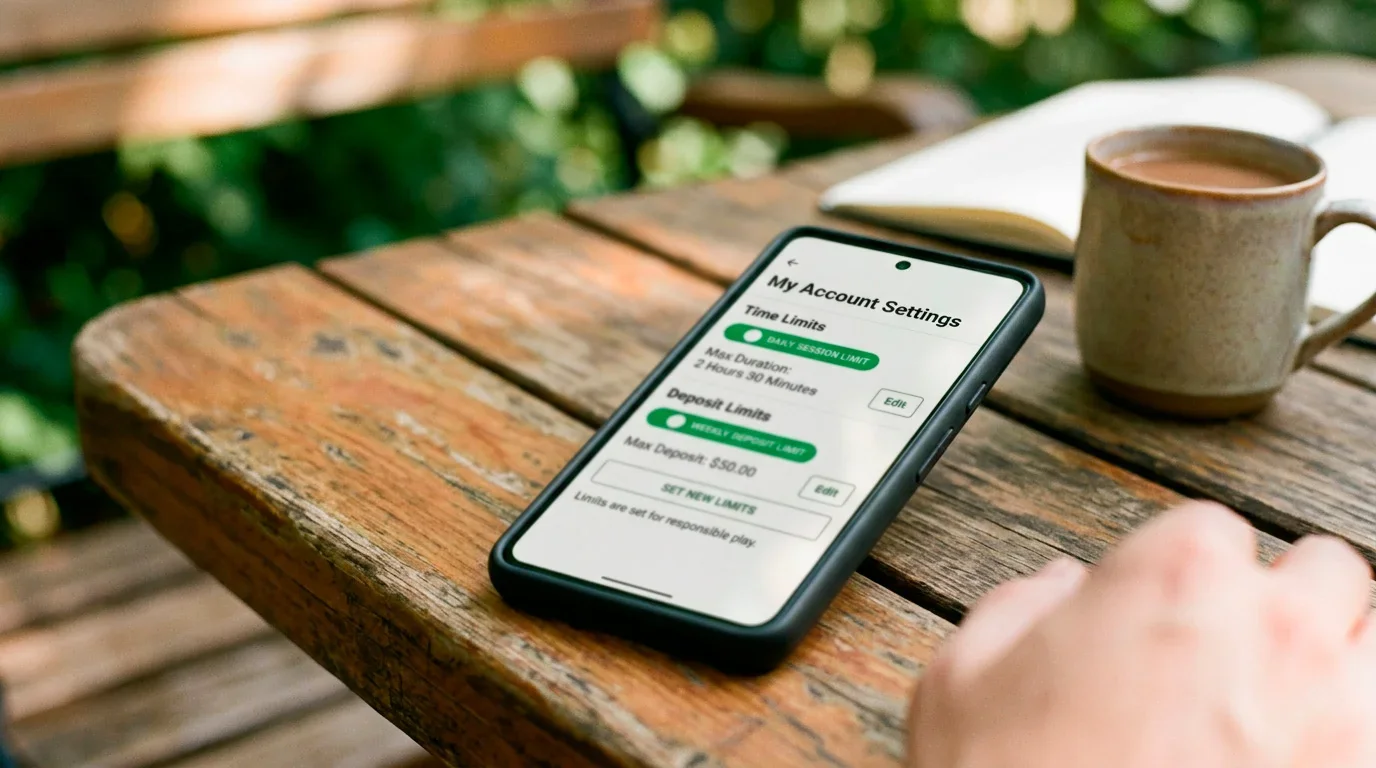
Every UKGC-licensed casino is required to make a defined set of responsible-gambling tools available to every player — deposit limits, session reality checks, cooling-off periods, self-exclusion. This guide focuses on the on-platform tools a player can use directly, the regulatory framework around them, and the support organisations available when on-platform tools are not enough. For self-exclusion specifically, see the GAMSTOP guide; for account closure (a different decision) see the account-closure guide.
Deposit, Loss, and Stake Limits — How to Set Them
Deposit limits, loss limits, and stake limits are the most-used responsible-gambling tool in the UK. Every UKGC remote licensee must offer all three, configurable on daily, weekly, and monthly windows. The player can set limits as low as they choose; increases take effect only after a cooling-off period (typically 24 hours, though specific cooling intervals vary).
Decreases take effect immediately. This asymmetry is deliberate: the regulator’s view is that a player tightening a limit should not be made to wait, while a player loosening one should be given time to reflect. The cooling-off window before an increase is enforced at the operator level under LCCP Social Responsibility Code 3.4.
Stake limits, distinct from deposit and loss limits, cap the per-spin or per-bet amount. UK online slots are subject to a mandatory £5-per-spin cap for players aged 25 and over (from 9 April 2025) and £2 for players aged 18 to 24 (from 21 May 2025). Players can voluntarily set their own lower stake limits on top of these mandatory caps.
Recommended online casinos
Session Reminders and Reality Checks
UKGC LCCP requires every operator to offer session-time reminders (“reality checks”) that surface at intervals the player can configure. The default is typically 60 minutes; players can set it shorter. The reminder shows time elapsed in the current session and net win or loss to date.
Reality checks pause the play screen until the player acknowledges the message. This is a deliberate design choice: a fully-passive notification can be dismissed without registering, but a click-to-continue gate forces the player to interact with the information. The operator cannot disable the feature; the player can only change the interval, not turn it off entirely.
Cooling-Off Periods Versus Self-Exclusion
Cooling-off periods are short, time-limited breaks from gambling — typically 24 hours, 7 days, 30 days, or up to 6 weeks at most UK operators. During a cooling-off period, the player cannot deposit, bet, or open new sessions; account access is preserved but locked from gambling activity.
Self-exclusion is a longer, more formal step: typically 6 months, 1 year, or 5 years (with a 5-year-with-auto-renewal option introduced in late 2024). Self-exclusion via GAMSTOP applies across every UKGC-licensed online operator simultaneously, not just the one the player initiated it from. The GAMSTOP guide covers the mechanics in depth.
By the end of 2025, around 562,000 people had registered with GAMSTOP, with new sign-ups averaging 319 per day in H2 2025 (GAMSTOP H2 2025 report).
How the £150 Affordability Threshold Fits In
UK financial-risk assessments — sometimes called affordability checks — trigger at £150 in net deposits over a rolling 30-day window. The check is “frictionless” for the vast majority of players: the operator pulls a soft credit-reference signal that confirms the player has no public-records financial distress (bankruptcy, CCJs, IVAs, debt-relief orders), with no documentation request and no impact on credit scores.
Approximately 3% of accounts trigger any additional intervention beyond the frictionless check, according to UKGC pilot data published in 2025. Where intervention occurs, it can include reduced deposit limits, a documentation request (payslips or bank statements), or a temporary block until verification is completed. The framework has been operational since February 2025.
Support Organisations Beyond the Operator
The on-platform tools are a first line, not the only line. UK players have access to a structured support ecosystem:
- GamCare runs the National Gambling Helpline (0808 8020 133) — 24/7, free, confidential, and available across England, Scotland, and Wales.
- GambleAware funds research, treatment, and prevention. Its 2024 Annual Treatment and Support Survey found that around 30% of adults who gamble and experience any level of problems want treatment or support — almost double the 17% recorded in 2020. Approximately 4.3 million UK adults are affected by someone else’s gambling.
- NHS specialist gambling clinics — 15 sites across England since 2019, with services for both gamblers and family members affected.
Estimates of problem-gambling prevalence vary by methodology. The UKGC’s current official survey, the Gambling Survey for Great Britain 2024 (published October 2025), identifies 2.7% of adults at PGSI 8+ (“problem gambling”), with a further 3.1% at moderate risk and 8.8% at low risk. The NHS Health Survey for England 2024, using an older PGSI methodology, reports less than 1% at PGSI 8+. Both surveys identify a substantial at-risk population in the millions.
Frequently Asked Questions
Published by the Luck Casino team.