
Luck Casino Jackpot Slots: How Progressives Work, What They Cost, and Realistic Odds
 Available in GB
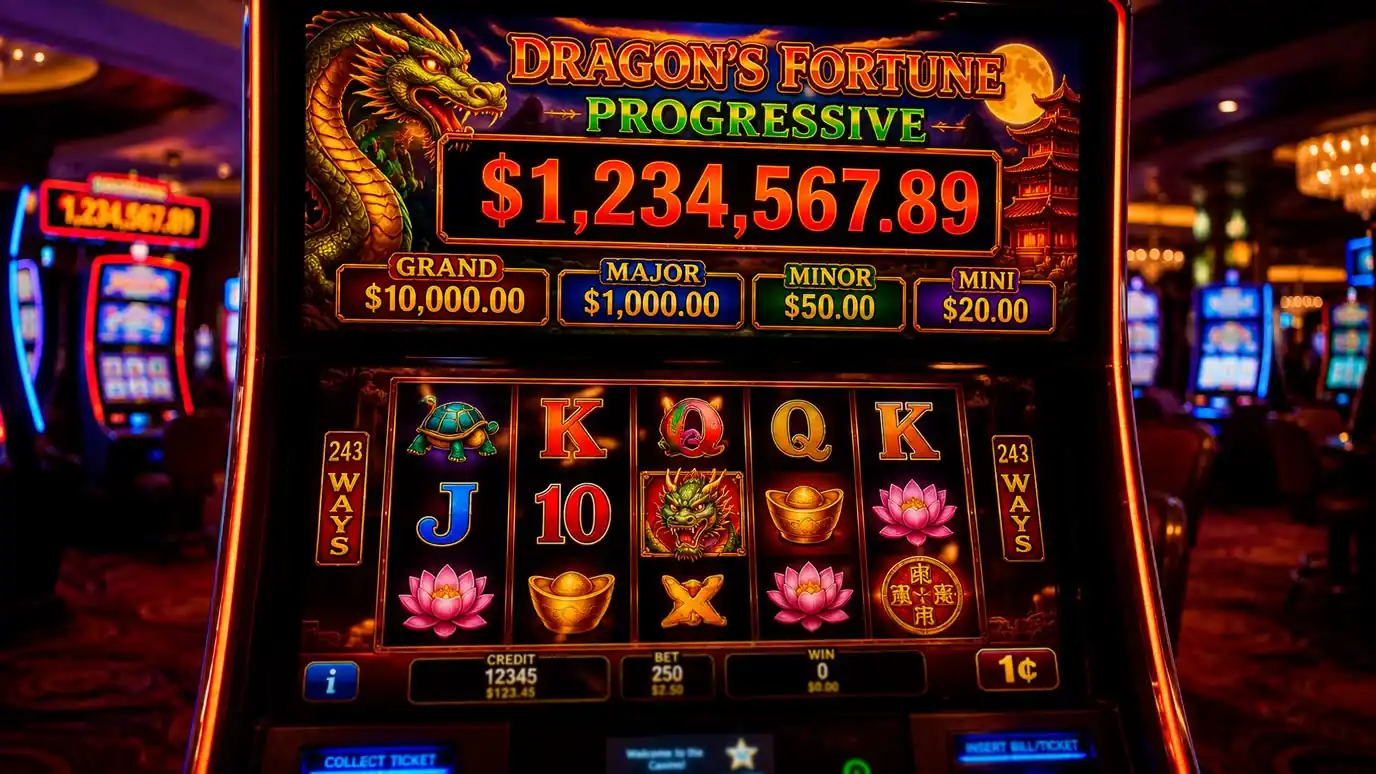
The largest online slot jackpot ever paid was worth more than most people earn in a lifetime. That single data point fuels an entire category of casino games — and simultaneously obscures the reality of what progressive jackpots actually cost the player in expected value. After auditing jackpot mechanics across multiple UK operators, including Luck Casino, I can tell you that the maths is less glamorous than the headlines suggest. Here is how these games actually work.
Progressive Jackpots: The Mechanics Behind the Number
A progressive jackpot grows incrementally with every bet placed on the game across all connected operators. A small percentage of each wager — typically 1% to 3% — feeds the jackpot pool. The remainder funds the base game’s standard payouts and the operator’s margin. This pooling mechanism is why progressives can reach seven-figure sums: thousands of players across dozens of casinos are all contributing to the same prize with every spin.
The jackpot itself is triggered by a specific in-game event — a particular symbol combination, a bonus-round outcome, or a randomly triggered award. The trigger mechanism varies by game and is determined by the provider’s mathematical model, not by the operator. The casino has no control over when the jackpot pays out, who wins it, or the conditions under which it triggers. The RNG governing the jackpot event is independently tested and certified as part of the provider’s UKGC licence.
Network progressives connect the same game across all operators that offer it. A player at Luck Casino and a player at a completely different UK casino are both contributing to and competing for the same jackpot. Local progressives, by contrast, are confined to a single operator’s player base, which means they grow more slowly and reach lower peaks. Some games offer tiered jackpots — a mini, a major, and a mega — each feeding from a different portion of the bet and triggering at different thresholds.
The key detail that most reviews omit: the jackpot contribution comes from the player’s bets, not from the operator’s pocket. When you play a progressive slot, a portion of your wager is diverted from the base game’s payout pool and redirected to the jackpot fund. This is why progressive slots have lower base-game RTP than non-progressive equivalents. A standard slot might return 96% in base gameplay. A progressive version of similar complexity might return 93% or 94% in base gameplay, with the missing 2-3% flowing into the jackpot pool.
The Real Cost: Base RTP vs. Combined RTP
Here is where the maths gets important. A progressive slot with a 93.5% base RTP and a 2.5% jackpot contribution has a combined theoretical RTP of 96% — comparable to a standard slot. But the 2.5% jackpot component is distributed extremely unevenly. One player in several million receives the full jackpot. Everyone else receives nothing from the jackpot portion of their bets. The expected value is mathematically identical to a 96% standard slot, but the variance is astronomically higher.
Slots dominate UK online casino revenue, generating about 84% of remote casino GGY in the year to March 2025 (UKGC industry statistics) on annual slot stakes of roughly £80 billion. Progressive jackpot slots represent a fraction of that total, but they punch above their weight in marketing terms because the headline numbers — millions of pounds in a single payout — generate the kind of attention that no standard slot can match.
For the individual player, the practical cost of playing progressives is the lower base-game RTP. Over a hundred spins at five pounds each (the maximum stake for players 25 and over under the 2025 cap), a standard 96% RTP slot produces an expected loss of twenty pounds. The same hundred spins on a 93.5% base-RTP progressive produce an expected base-game loss of thirty-two pounds fifty. The twelve-pound-fifty difference is your ticket price for a chance at the jackpot — a chance measured in odds of one in several million per spin.
Jackpot Availability at Luck Casino
Luck Casino’s game library includes progressive jackpot titles from providers who operate the largest jackpot networks in the UK market. The specific titles available rotate as providers release new games and retire older ones, but the structural characteristics remain consistent: network-linked pools, tiered jackpot levels, and base-game RTP values that reflect the jackpot contribution.
Daily jackpots and “must drop” jackpots — pioneered by Red Tiger — offer a different proposition. These jackpots are guaranteed to pay out before they reach a specified value or before a specified time. The individual payouts are far smaller than network progressives (hundreds or low thousands of pounds rather than millions), but the frequency is dramatically higher. The trade-off is explicit: smaller prizes, better odds, same mathematical principle of a bet-funded pool distributed to a randomly selected winner.
When evaluating jackpot games at Luck Casino, check the base-game RTP separately from any jackpot contribution. The in-game information panel should display the base RTP; the jackpot contribution is sometimes listed separately or can be calculated from the provider’s published data. If the combined RTP (base plus jackpot) falls below 95%, the game is extracting a higher-than-average house edge from your bets regardless of the jackpot’s headline size. The game provider profiles cover how different studios approach jackpot mechanics and RTP disclosure.
Recommended online casinos
Should You Play Jackpot Slots? A Framework for the Decision
I do not tell people whether to play jackpot slots. I give them the framework to decide for themselves, and the framework has three parts.
First, understand what you are paying. The reduced base-game RTP is a measurable cost per session. If you play progressive slots regularly, you will lose more per session than you would on equivalent non-progressive games. That is a fact, not an opinion.
Second, assess your relationship with the jackpot itself. If the possibility of a life-changing win enhances your entertainment value sufficiently to justify the higher per-session cost, the decision is rational within your personal utility function. If you are chasing the jackpot as a financial strategy — playing progressives because you believe you are due a win or because you need the money — the decision is irrational and potentially harmful.
Third, apply the same bankroll discipline as any other game. The stake caps help — five pounds per spin puts a structural ceiling on per-spin exposure. But the lower base RTP means your bankroll depletes faster on progressives than on standard slots at the same stake. Budget accordingly, and treat the jackpot as a lottery-like bonus layered on top of a standard slot session, not as the expected outcome.
What are the odds of hitting a progressive jackpot?
The odds depend on the specific game’s mathematical model and are typically in the range of one in several million per spin for major network jackpots. Tiered jackpots with smaller prizes have proportionally better odds. The exact probability is built into the game’s certified RNG and is not disclosed publicly by most providers.
Do progressive jackpots have lower RTP than regular slots?
Progressive jackpot slots typically have lower base-game RTP than non-progressive slots because a portion of each bet (usually 1-3%) feeds the jackpot pool instead of funding base-game payouts. The combined RTP (base game plus jackpot contribution) may be comparable to standard slots, but the jackpot portion is distributed to very few winners.
Prepared by the Luck Casino editorial staff.